> For the complete documentation index, see [llms.txt](https://docs.tradefi.bot/whitepaper/llms.txt). Markdown versions of documentation pages are available by appending `.md` to page URLs; this page is available as [Markdown](https://docs.tradefi.bot/whitepaper/ai-trading-agents-bots/al-ai-agent-ranger-reversor-v1-or-tradefi.bot-eth-usdt-45m/iv.-editable-parameters-and-interpretation.md).
# IV. Editable Parameters & Interpretation
The **AL/AI Agent Ranger Reversor v1** is highly modular and was designed to give you full control over its behavior — without needing to code.
Each input represents a lever of control over how the agent reads the market, reacts to signals, and manages open positions. While the default configuration is battle-tested, advanced users can fine-tune it to fit their risk appetite and strategy style.
***
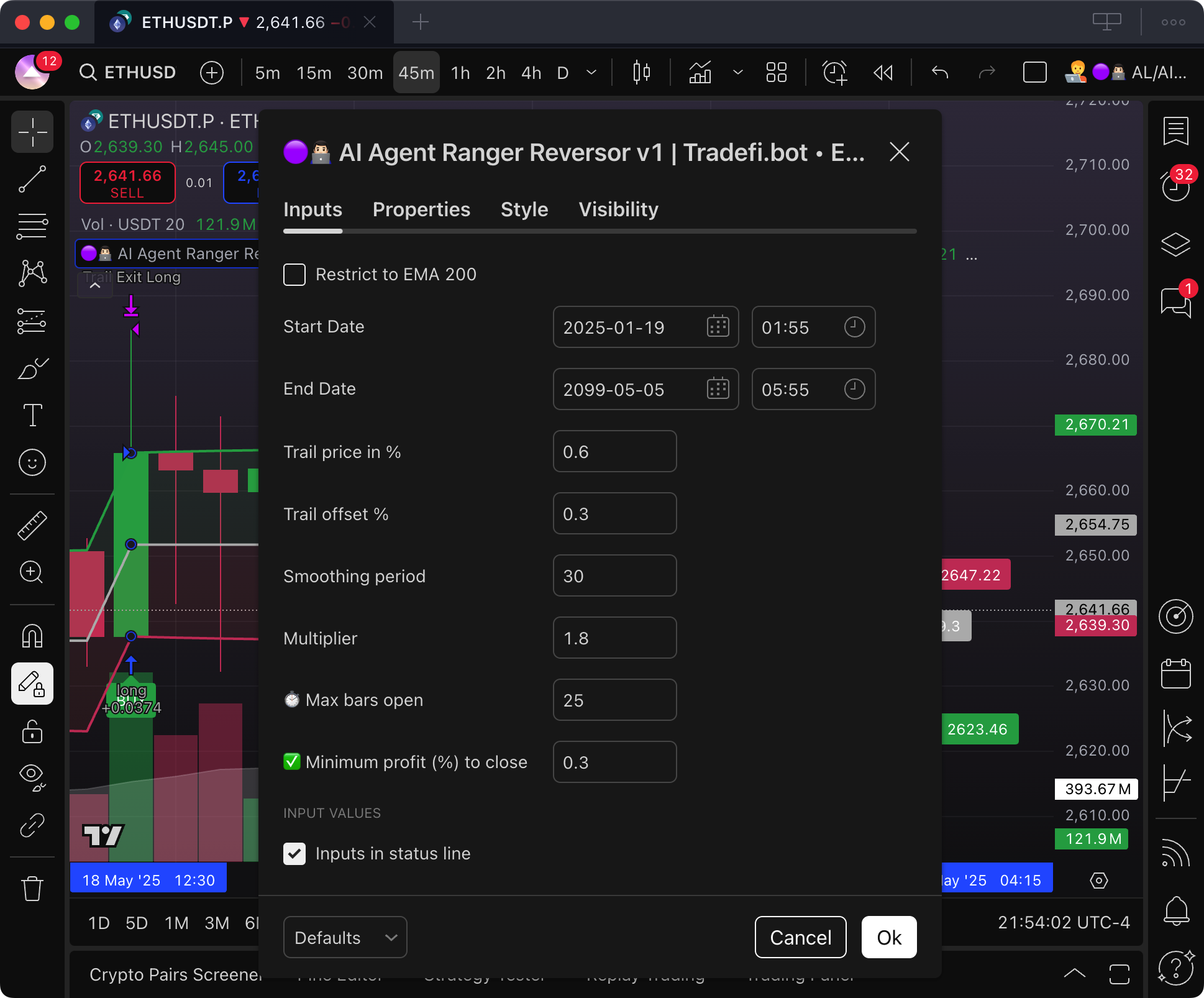
### 🎯 Trailing Logic
#### • `trailLevel` – Trailing Target %
Defines how far above or below the current price the trailing stop will sit.\
Higher values = more space for trend to grow before locking profit.\
Lower values = tighter profit capture.
> 💡 Useful for adjusting aggressiveness in volatile markets.
***
#### • `trailPoints` – Trailing Activation Threshold
Determines how much price must move in your favor before the trailing begins.\
This acts like a buffer — giving space for the trade to “breathe.”
***
### 📐 Range Filter Smoothing
#### • `per` – Filter Smoothing Period
The number of candles used to detect range behavior.\
Shorter periods = more reactive filter.\
Longer periods = smoother, more stable signals.
#### • `mult` – Filter Sensitivity Multiplier
Controls how “wide” or “tight” the range band is.\
Affects how fast the bot reacts to breakouts.
***
### 📏 Trend Filter Option
#### • `RestrictToEMA200` – Enable/Disable Long-Term Filter
When enabled:
* Longs are only taken when price is above the EMA200
* Shorts only below
Helps filter signals in strong trending conditions.
***
### ⏱️ Time-Based Controls
#### • `maxBarsOpen` – Maximum Bars in Trade
Defines how long (in bars) the bot can hold a position.\
Once this is exceeded, the agent force-closes the trade.
> ⚠️ Prevents trades from stalling or going stale during sideways conditions.
***
#### • `minProfitTarget` – Minimum Profit %
If the trade reaches this profit, it’s closed automatically — even if the trailing or time limits aren’t hit.\
A useful layer for conservative profit-taking.
***
### 🧪 Backtest Range
#### • `startdate` & `enddate`
Let you define the exact range of candles for testing and simulation.\
This ensures clarity when running clean backtests, avoiding historical noise or data overlap.
***
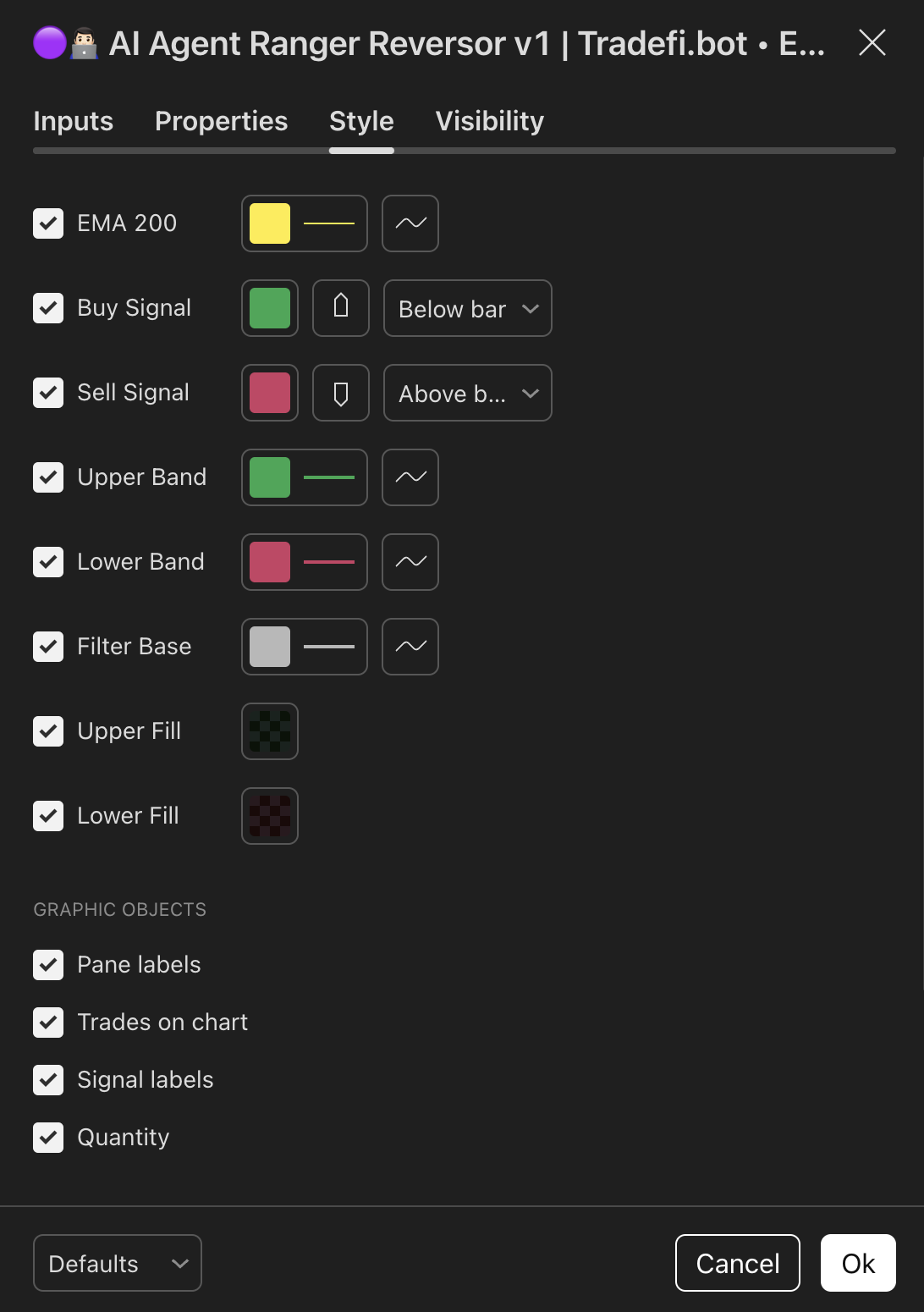
### 🎨 Visual Settings
While most visuals are optimized by default, you can tweak:
* **Line thickness** of bands and filter base
* **Colors** of the channel:
* Green for upper band (profit zone)
* Red for lower band (risk zone)
* White for base filter
* Yellow for EMA200
* **Opacity** of shaded zones for visual clarity\
> 🧠 All visuals are designed to be minimal, elegant, and informative — just like a trading cockpit.
***
### 📌 Default Configuration Snapshot
| Parameter | Default |
| ------------------ | ---------- |
| `trailLevel` | 0.6% |
| `trailPoints` | 0.3% |
| `per` | 30 candles |
| `mult` | 1.8 |
| `RestrictToEMA200` | false |
| `maxBarsOpen` | 25 bars |
| `minProfitTarget` | 0.3% |
> ⚠️ If you're not an advanced user, we recommend keeping these values as-is. The agent was optimized for ETH/USDT on the 45M timeframe.
***
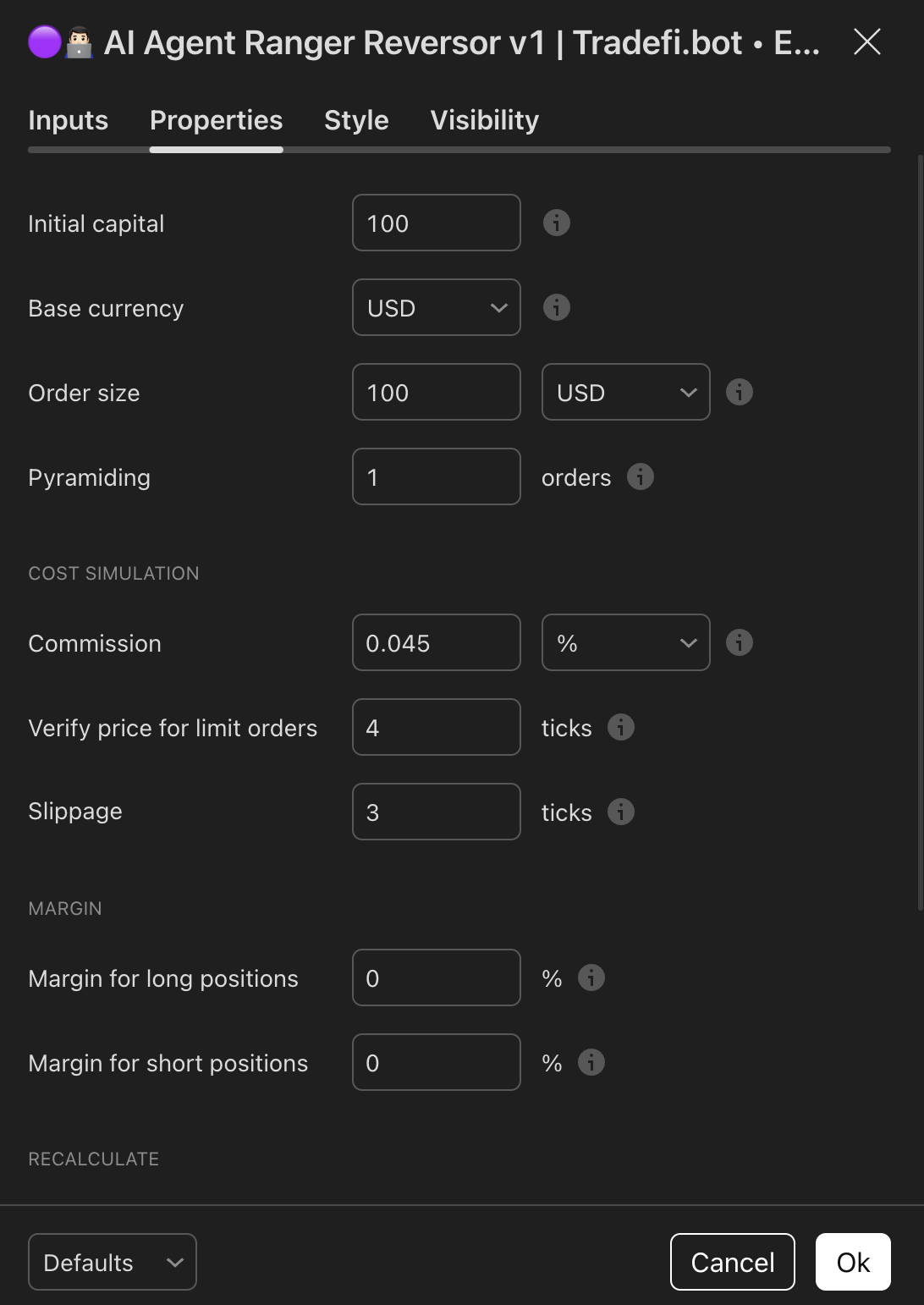
### ⚙️ Strategy Simulation Settings (Properties Tab)
The following options affect how the bot behaves inside TradingView’s strategy tester:
#### • Initial Capital
* Default: `$100`
* Set this to simulate portfolio size. It does not affect strategy logic.
#### • Order Size
* Default: `$100`
* Determines how much virtual capital the agent uses per trade.
#### • Commission
* Default: `0.045%`
* Reflects the trading fee used by most centralized exchanges like OKX, Binance, or Bybit.
#### • Slippage
* Default: `3 ticks`
* Introduces execution friction to reflect real-world conditions.
***
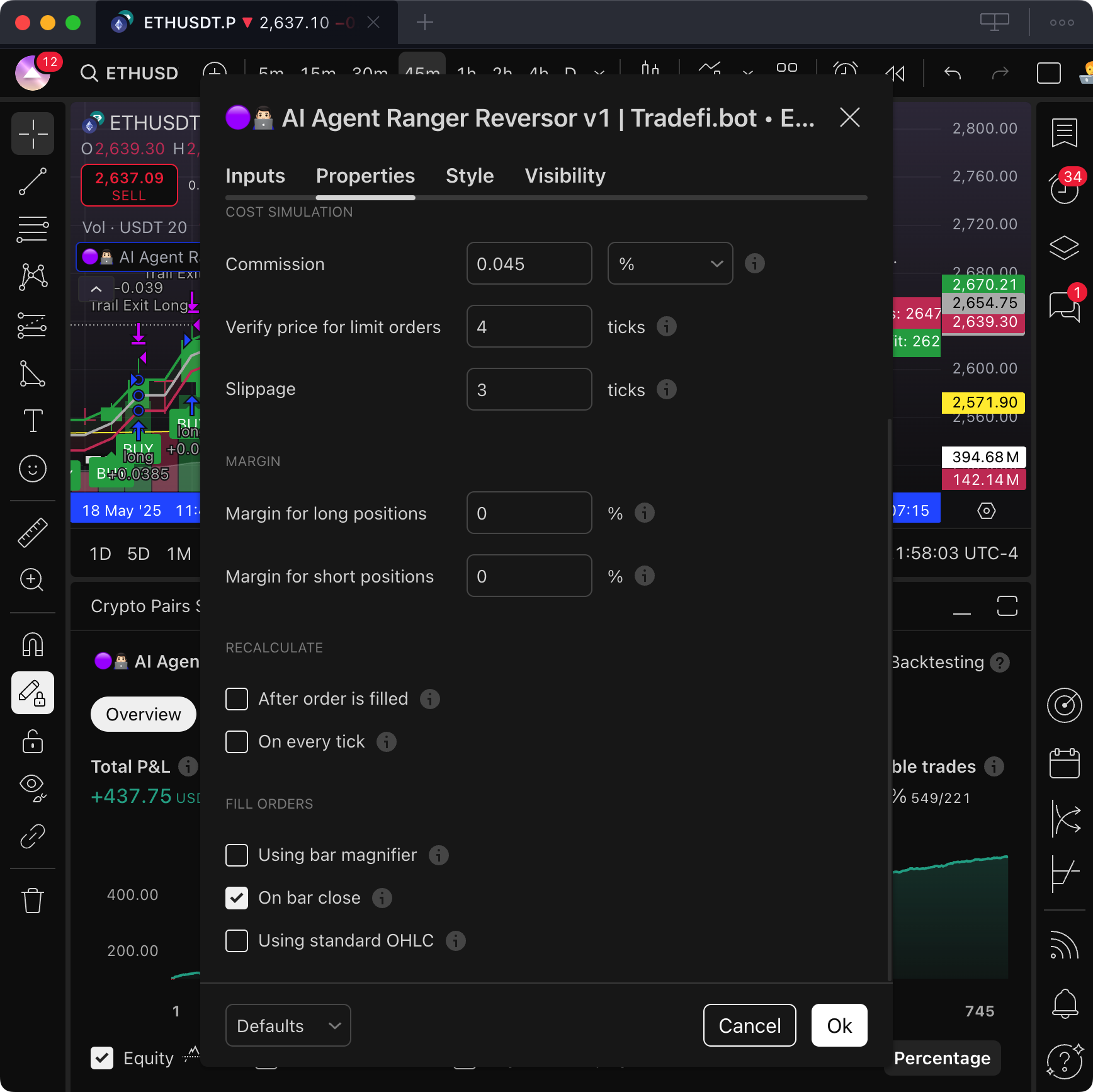
### 🔁 Execution Logic (Fill Settings)
#### • Recalculation
* `After order is filled`: ❌ Off
* `On every tick`: ❌ Off
* Designed for consistency — not micro noise.
#### • Fill Orders
* ✅ `On bar close`: enabled
* ❌ `Using bar magnifier`: disabled
* ❌ `Using standard OHLC`: disabled
> 📌 We recommend keeping these defaults unless you are testing an ultra-high-frequency variation.
***