> For the complete documentation index, see [llms.txt](https://docs.tradefi.bot/whitepaper/llms.txt). Markdown versions of documentation pages are available by appending `.md` to page URLs; this page is available as [Markdown](https://docs.tradefi.bot/whitepaper/biweekly-usdt-dividends/where-do-the-biweekly-usdt-dividends-come-from.md).
# Where do the Biweekly USDT Dividends come from?
Source of Biweekly USDT Dividends
{% hint style="success" %}
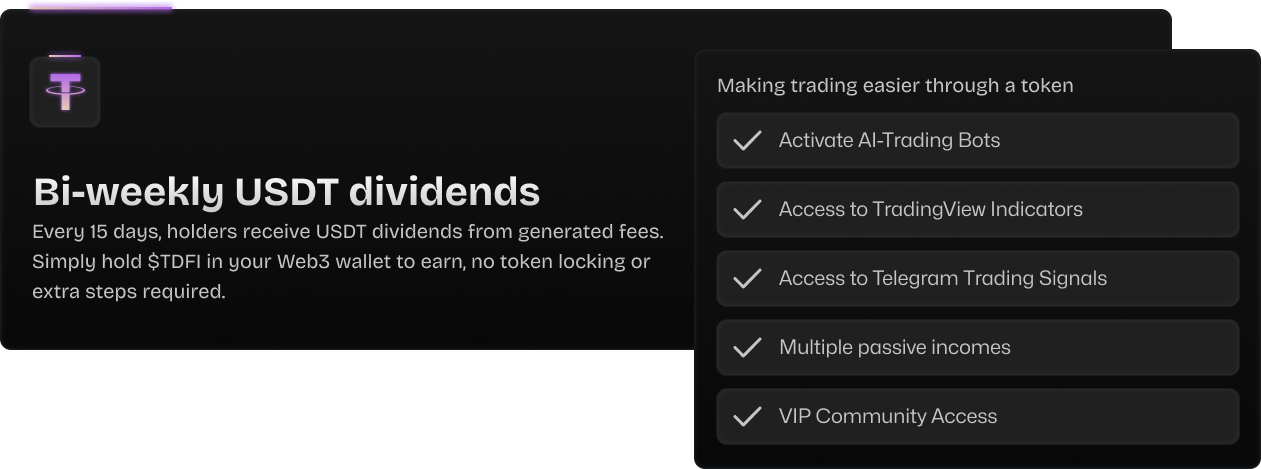
In the Tradefi.bot ecosystem, the biweekly dividends in USDT distributed to $TDFI holders **come from a well-structured mechanism that ensures the sustainability and consistency of these payments.** Here’s a detailed explanation of the sources of the biweekly dividends:
{% endhint %}
{% hint style="info" %}
These fees are applied to transactions involving $TDFI tokens. The 2.5% entry fee is charged when buying TDFI, while the 5% penalty fee is imposed on sellers. A portion of these fees goes into the dividend pool, benefiting long-term holders and discouraging frequent trading. Users can offset these fees through biweekly dividends, compounding interest, and participation in the pre-sale.
{% endhint %}
## Sources of the Biweekly Dividends
1. **Entry Fee and Penalty Fes for Sellers**:
* **2.5% Entry Fee**: Every time a user purchases $TDFI tokens, a 2.5% entry fee is applied. Part of this fee is directed to the dividend pool, contributing to the accumulation of USDT that is later distributed to $TDFI holders.
* **5% Penalty Fee for Sellers**: When selling $TDFI tokens, a 5% penalty fee is applied. A portion of this fee also goes to the dividend pool, ensuring a consistent contribution to the pool that supports the dividend payments.
* *Please note that while there are entry and penalty fees for sellers, these costs can be quickly offset by leveraging our Trading Bots, receiving biweekly dividends, and participating in the Pre-sale. These features offer lucrative opportunities to maximize returns and recoup any incurred fees efficiently.*
2. **Trading Fees:** A portion of the fees generated from trading activities conducted on the platform, including decentralized trading bots and manual trading, is collected to fund the biweekly dividends.
3. **Platform Usage Fees:** Fees collected from users accessing premium features, participating in special events, or utilizing additional services within the Tradefi.bot ecosystem contribute to the dividend pool.
4. **Strategic Partnerships:** Collaborations with external partners may involve fee-sharing arrangements, where a portion of the fees generated from joint activities is allocated towards the biweekly dividends.
5. **Affiliate Program:** The referral bonus program incentivizes users to invite others to the platform, with a percentage of the fees generated from referred users' transactions contributing to the dividend pool.
6. **Claiming Rewards:** Fees may be associated with claiming rewards earned from various activities on the platform, such as staking, participating in liquidity pools, or completing specific tasks.
7. **Fee Redistribution**:
* **Fund Allocation**: The fees collected (both entry and penalty fees) are strategically redistributed. Of the total fees collected, 50% is directly allocated to the dividend pool.
* **USDT Dividend Pool**: This pool, denominated in USDT, accumulates over a 15-day period and is prepared for distribution to $TDFI holders in a regular and transparent manner.
8. **Platform-Generated Revenues**:
* **Platform Activities**: Revenues generated through various activities within the Tradefi.bot platform, such as trading transactions and bot usage, can also contribute to the dividend pool. This ensures that the dividends are not solely dependent on entry and penalty fees but also on the platform’s overall activity and growth.
* **Resource Optimization**: The platform ensures that resources are effectively optimized to maintain a steady and sustainable flow of funds into the dividend pool.
9. **Maintenance and Transparency**:
* **Audit and Monitoring**: The dividend pool and distribution mechanisms are regularly audited and monitored to ensure transparency and user trust. This practice ensures that the funds are managed properly and distributed equitably.
* **Open Communication**: Tradefi.bot is committed to maintaining open communication with its community about the accumulation and distribution of biweekly dividends. Regular updates and detailed reports strengthen transparency and trust in the process.
10. **Other Revenue Streams:** Revenue generated from various sources, such as ecosystem expansions, strategic investments, or community contributions, may also be allocated towards the biweekly dividends for TDFI holders.
## Impact on the Ecosystem
1. **Incentivizing Holding**:
* **Benefits for Holders**: The biweekly dividend mechanism is designed to reward long-term $TDFI holders, incentivizing holding and reducing sell pressure. This contributes to the stability and growth of the token’s value.
* **Sustainability**: By maintaining a steady flow of funds into the dividend pool, Tradefi.bot ensures that dividend payments are sustainable over the long term, providing a reliable source of passive income for holders.
2. **Encouraging Platform Activity**:
* **Increased Participation**: Entry and penalty fees, along with platform-generated revenues, not only support the dividend pool but also encourage greater participation and activity within the Tradefi.bot ecosystem.
* **Ecosystem Growth**: As the platform grows and attracts more users, the accumulation of funds for biweekly dividends strengthens, benefiting all participants in the ecosystem.
> The **biweekly dividends** of $TDFI come from a well-designed system of entry and penalty fees, along with platform-generated revenues. This mechanism ensures the sustainability and consistency of dividend payments, rewarding $TDFI holders with regular passive income in USDT. By participating in the Tradefi.bot ecosystem, you can benefit from a reliable source of passive income while contributing to the project's growth and success.